A practical guide for food brands, importers, and packaging buyers.
Mingchu Packaging | Updated September 20, 2026
Featured image: AI-generated illustration. The pouch appearance does not establish material composition, food-contact compliance, or PPWR conformity.
Before you change a food pouch for the EU market, first lock down the intended use, the evidence behind the finished pack, and the parties responsible for each document.
This checklist helps you identify missing evidence, compare redesign options, and brief suppliers without treating a single certificate as the answer.
Who is this guide for?
This guide is for brands, importers, and buyers sourcing plastic films and laminated flexible packs for food sold in the European Union. It is not a substitute for a product-specific compliance assessment.
Pet food, cosmetics, and household goods may follow different food-contact or sector-specific routes and should not be assessed through the food branch of this checklist.[3][4]
The Packaging and Packaging Waste Regulation, Regulation (EU) 2025/40, generally applies from August 12, 2026. Its labelling, recyclability and other obligations do not all start on the same date.
Deal with requirements that apply to the current order first, then plan structural changes against the relevant implementing or delegated acts.[1][2]
Start with the actual conditions of use
A pouch for ambient dry food is not assessed in the same way as a pouch for hot-filled sauces.
Before requesting quotes, specify:
- Food type: Identify the food that will contact the packaging.
- Contact time and temperature: Define the expected conditions of use.
- Processing and storage conditions: State whether the pouch will be frozen, hot-filled or retorted.
- Target shelf life: Specify the required storage period.
Food-contact compliance also depends on the framework rules, good manufacturing practice, and any applicable plastics rules.[3]
What restricted-substance evidence should buyers check?
PFAS is a group of per- and polyfluoroalkyl substances. In a packaging review, targeted PFAS findings, polymeric PFAS content, and total-fluorine screening are different measures.
Targeted PFAS findings, polymeric PFAS content, and total-fluorine screening should not be described as though they were one legal limit.[1, Article 5]
Restricted-substance checks
| Item | What to check |
|---|---|
| Lead, cadmium, mercury and hexavalent chromium | The sum of the four concentrations in packaging or a packaging component must not exceed 100 mg/kg. |
| Targeted PFAS | A pack may not be placed on the market when a single PFAS reaches or exceeds 25 ppb, or the total reaches or exceeds 250 ppb. Polymeric PFAS is excluded from these two quantitative calculations. |
| PFAS including polymeric PFAS | A pack may not be placed on the market at or above 50 ppm. Where total fluorine exceeds 50 mg/kg, evidence may also be required to show whether the fluorine comes from PFAS or non-PFAS sources. Total fluorine is not the same legal PFAS limit. |
What to request with a test report
When asking for a report, request the tested sample, method, reporting or quantification limits, analytes, and the batch or material scope.
A result that says only “not detected” without a stated analytical scope does not establish the position of your finished pouch.
Which supplier documents should match the finished pouch?
The title of a document is not enough. Check what it proves, then check whether the sample, structure, and conditions of use cover your order.
Supplier documents should cover the actual finished pouch and intended use, with any gaps clearly identified.
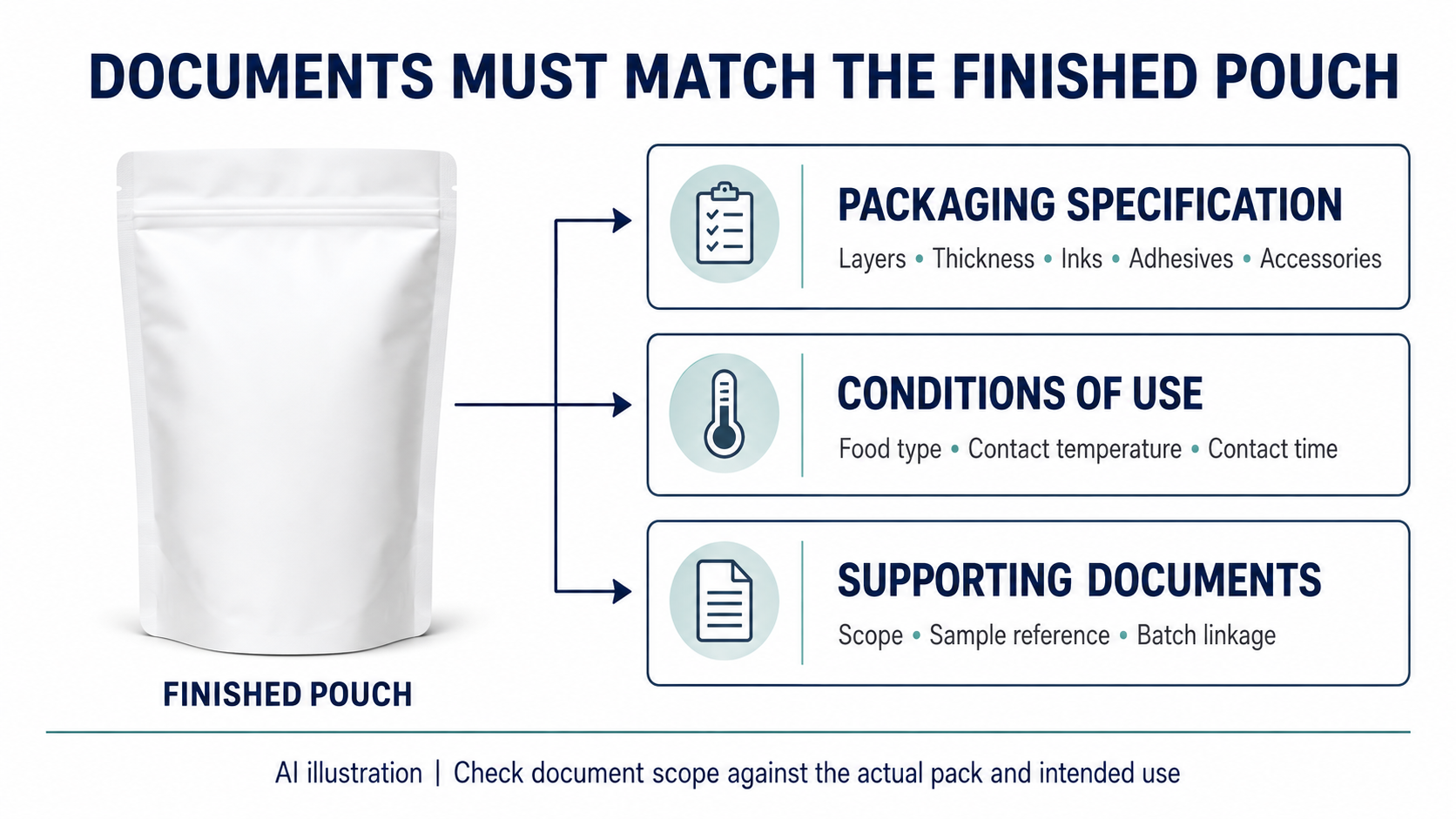
Figure 1: A finished pouch should be matched to its specification, conditions of use, and supporting documents. AI-generated illustration; each document must be checked against the actual pack and intended use.
Supplier document checklist
| Request | Key verification points |
|---|---|
| Packaging specification | Full layer sequence, thickness of each layer, total grammage or pack weight, plus inks, adhesives, coatings, zippers and other components. |
| Substance-compliance evidence | Material grade, restricted-substance scope, tested batch or coverage statement. Record anything not covered as an evidence gap. |
| Food-contact support | Applicable rules, intended use, contact conditions, migration testing or other compliance rationale. Check the declaration for plastic food-contact materials where applicable. |
| Recyclability design assessment | Assessment system, version, target recycling stream, and the complete pack configuration. Separate design advice, test results, and a legal conformity conclusion. |
| Change and traceability records | How formulation or supplier changes are communicated and how raw-material lots, finished-pack lots, and supporting evidence are linked. |
For example, a report for unprinted PE film may not cover the printed laminated zipper pouch you purchase. Ask where the film report stops and what evidence covers inks, adhesives, and accessories.
Whether a finished-pack test is needed must follow a compliance assessment, not an assumption based on the base film report.
Do not merge declarations with different purposes
The PPWR EU Declaration of Conformity and a Declaration of Compliance for plastic food-contact materials serve different legal purposes.
Both may be shortened to “DoC”, but the regulatory scope and supporting documents must be checked separately.[1, Article 39 and Annex VIII][3]
Who is responsible for conformity declarations and EPR?
Responsibility depends on the legal role and the actual transaction route, not simply on the company’s commercial description.
Confirm the PPWR declaration signatory and the EPR party separately. Do not assume that the same company is responsible for both.
PPWR declaration responsibility
Under PPWR, the EU Declaration of Conformity is the responsibility of the manufacturer in the legal sense.
Own-brand manufacturing, relabelling or repackaging after import, and certain micro-enterprise exceptions can change the analysis.
Do not assign the signing responsibility merely because a company is called a brand owner or a packaging factory.[1, Articles 3, 15 and 21]
EPR responsibility
Extended producer responsibility, or EPR, should be identified country by country, based on the selling route and packaging category.
The producer, registration route, reporting, and any PRO arrangement depend on the target Member State. A blanket statement that every company must contract with a PRO is not reliable.[1, Articles 44 to 47]
How should buyers compare replacement packaging structures?
When comparing replacement structures, keep the food use, pouch format, dimensions, and acceptance criteria constant. Only then should you compare reduced layers or alternative materials.
Evaluate recycling design and food protection together. “Easier to recycle” does not automatically mean “suitable for this food”.
Packaging structure comparison
| Structure | Check before changing | Verify after changing |
|---|---|---|
| PET / AL / PE foil laminate | How layers and accessories affect the target recycling stream, and whether the existing barrier and light protection are necessary. | Oxygen, moisture, light, seal performance, and shelf-life requirements for the same food. |
| PET / PE or BOPP / PE | Compatibility of films, adhesive, inks, and accessories as a complete pack, not only the main resin. | Print, lamination, pouch conversion and filling compatibility, plus seal and barrier performance after distribution. |
| PE-based laminate such as MDO-PE / PE | Full formulation, coatings, barrier layers, inks and zipper. PE-based does not by itself establish a statutory recyclability grade. | Stiffness, heat resistance, line performance, seal window, and barrier needs together. |
MDO-PE is a machine-direction-oriented PE film, not a finished-pouch specification.
In a supplier comparison, request the complete layer sequence, thicknesses, coatings and accessories rather than comparing a film name with a full laminate structure.
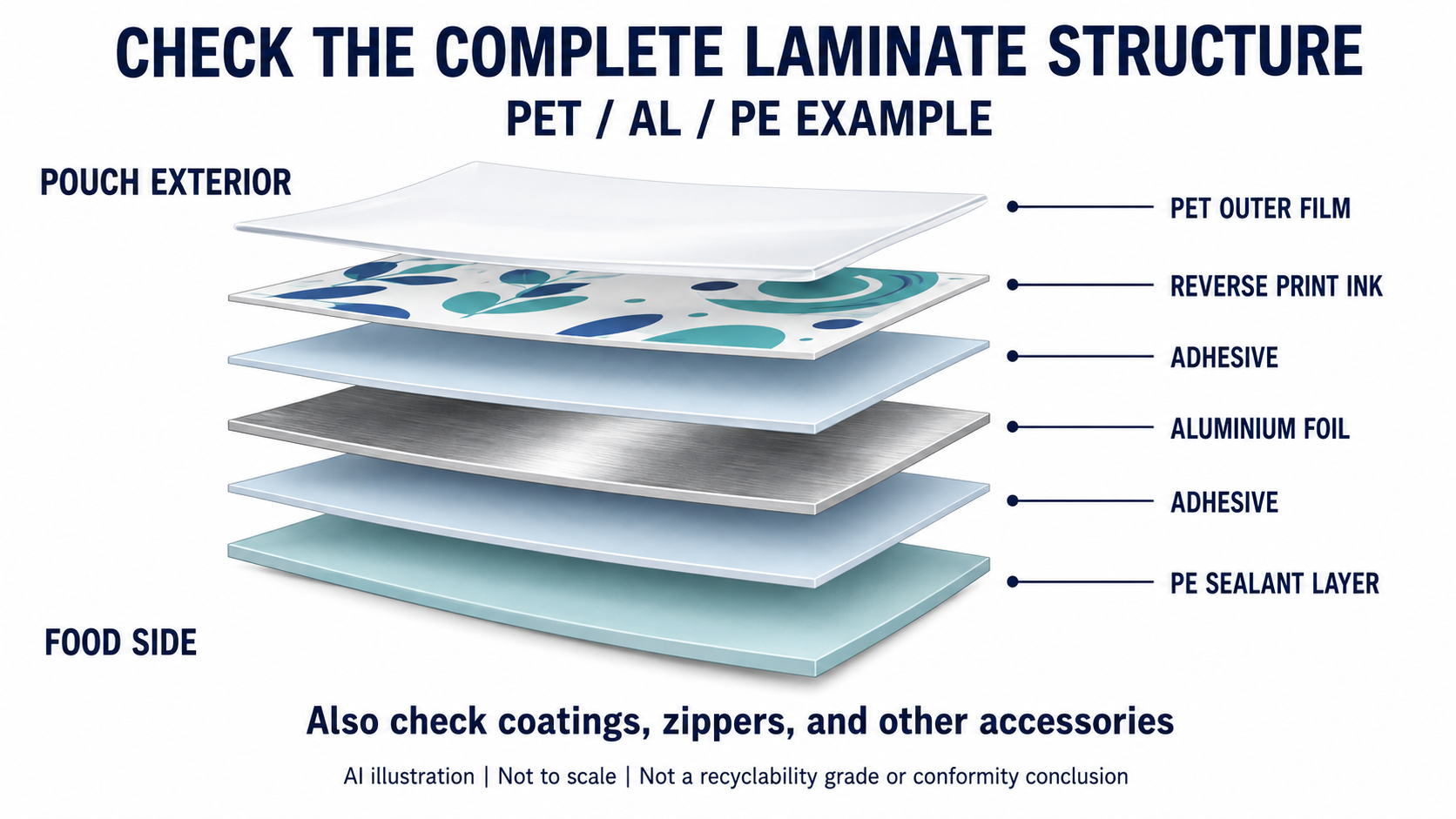
Figure 2: Where to verify components in a PET AL PE printed laminate. AI-generated illustration, not to scale and not a statement of recyclability grade or conformity.
Compare costs on like-for-like specifications
Ask suppliers to quote the same pouch type, dimensions, order quantity, number of print colours, and testing requirements.
Separate material, conversion, cylinder or plate, and validation costs.
A price index for three-side seal pouches, stand-up pouches, or quad-seal formats cannot substitute for the cost difference between two material structures.
Use this sequence for a redesign
- Fix the intended use and acceptance criteria: Collect the full specification and evidence for the current pouch.
- Identify what changes: Ask the supplier which materials or processes change in each candidate structure and which evidence is still missing.
- Arrange validation and assessment: Arrange sample validation and an appropriate compliance assessment. Treat shelf-life changes as a separate validation plan.
- Update the documentation: Update specifications, declarations, and traceability records after the result is confirmed, then agree the production changeover lot.
Which PPWR dates matter for procurement planning?
A legislative deadline is not automatically the implementation date for every business. Where the text says “whichever is later”, continue to monitor the linked act.[1][2]
Split the purchase plan into “evidence needed for this order” and “future structural development”.
Key milestones and buyer actions
| Milestone | What a buyer should do |
|---|---|
| General application from August 12, 2026 | Check the restricted-substance, responsibility, and documentation requirements that apply to the current pack. The food-contact PFAS restriction is already applicable. |
| Material-composition labelling | August 12, 2028 or 24 months after the relevant implementing act enters into force, whichever is later. Confirm scope and exemptions before changing artwork. |
| Recyclability performance entry criteria | January 1, 2030 or 24 months after the relevant delegated act enters into force, whichever is later. From 2038, only grades A and B are permitted, subject to applicable exemptions. |
| Recycling at scale | January 1, 2035 or five years after the relevant implementing act enters into force, whichever is later. Keep tracking the target recycling stream and assessment requirements. |
These milestones are directly relevant to the procurement task in this guide.
Recycled content, packaging minimisation, and specific packaging restrictions should also be assessed for the product line as a whole. This table is not a complete PPWR implementation plan.[1]
What should be checked before placing a purchase order?
Use this checklist to record what has been confirmed and what still needs supporting evidence.
Before opening the purchase order, confirm the pack specification, document coverage, responsible parties, and change-control plan.
Purchase-order checklist
- Destination and use: Target EU Member State, food use, and sales route are stated.
- Complete specification: The specification lists films, inks, adhesive, coatings, and accessories.
- Document coverage: Supplier documents cover the finished pouch and the expected conditions of use; each gap has an owner.
- Separate evidence streams: Restricted substances, food contact, and recyclability design are checked as separate evidence streams.
- Responsible parties: The declaration signatory and EPR party are confirmed for the actual transaction route.
- Change control: Material or formulation changes have an assessment, validation, and document-update plan.
- Current and future requirements: Requirements for the current order are recorded separately from future redesign milestones.
Supplier brief you can copy
Use the following as the body of an enquiry email and ask the supplier to respond point by point.
Destination country: ; food type: ; contact temperature and time: ; frozen / hot-fill / retort conditions: ; target shelf life: ____.
Current complete pack structure: ; pouch format and dimensions: ; accessories: ; order quantity per SKU: ; planned launch or changeover date: ____.
Please list the raw-material and finished-pack supporting documents you can provide, the scope covered by each document, assessments or tests still needed, and documents that must be updated after a material change.
Frequently asked questions
A customer asks for a PPWR certificate. What should I ask first?
Ask the customer to name the document, applicable provision, and packaging concerned. A third-party report, a recyclability assessment, and a manufacturer declaration prove different things.
Prepare evidence for the specified need rather than searching for a generic document called a PPWR certificate.[1]
Does a material safety data sheet replace other evidence?
No conclusion should be drawn from that alone. First confirm whether it covers restricted substances, food-contact use, and the actual packaging configuration.
A material safety data sheet can help your review, but it does not automatically fill a missing assessment or test.
Is PFAS-free the same as meeting a legal threshold?
Not necessarily. Ask whether PFAS-free means no intentionally added PFAS, not detected within a specified analytical scope, or a separate purchasing standard.
Contractual requirements may be stricter than regulatory thresholds, so agree the analytical scope and quantification limit as well.
Can a recycling-compatibility certification replace a PPWR declaration?
Check the certification scope and standard used.
A third-party recyclability assessment may support the file, but it does not automatically establish compliance with all PPWR obligations or guarantee a future statutory grade.[1]
If reverse-printed ink does not touch food, can it be ignored?
It still needs review. No direct food contact does not prove that relevant substances cannot migrate through the substrate or transfer during production.
Collect safety support for the full structure, production process, and intended use.[3]
Can the original shelf life be kept after moving to a mono-material pouch?
Do not assume so. Review the new structure, seals, and barrier performance, then validate it against the food and storage conditions.
Supplier film data is useful input; it does not independently prove the shelf life of the food product.
Conclusion
Contact Mingchu with the destination country, food use, conditions of use, and current packaging structure. Mingchu can help you structure a flexible-packaging selection brief and identify the material-document gaps, so you know what to request from suppliers and what needs validation next.
This guide supports procurement communication and evidence collection. Product-specific conformity conclusions must be based on applicable law, complete technical documentation, and an appropriate assessment.
Legal and reference sources
Regulatory references checked on September 20, 2026. The numbered references match the text. Applicability depends on the relevant legal provisions, associated acts, and requirements in the target market.